
Product Details
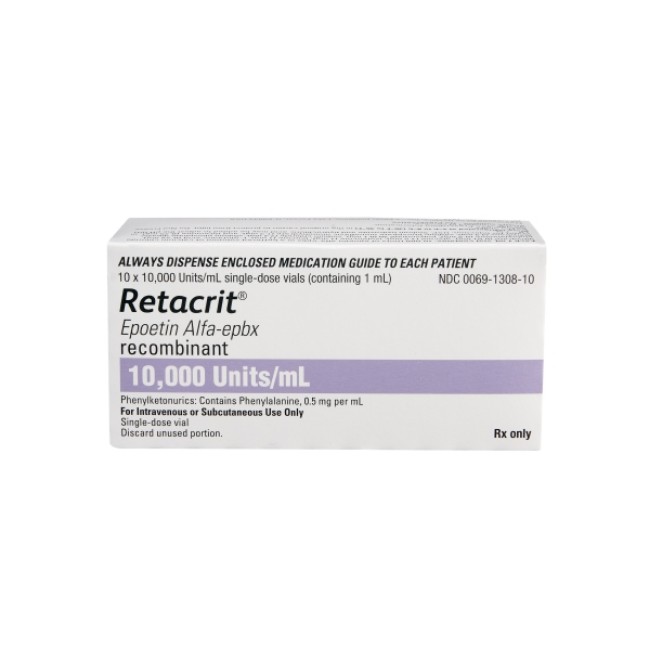
RETACRIT 10000U/ML 1ML SDV 10/PAC
Manufacturer: Pfizer
MFG#: 00069-1308-10
NDC: 00069-1308-10
PID: 323428
Product Information
| NDC Package Code | 0069-1308-10 |
| Proprietary Name | Retacrit |
| Non-Proprietary Name | Epoetin Alfa-epbx |
| Package | 10 VIAL, SINGLE-DOSE in 1 CARTON (0069-1308-10) / 1 mL in 1 VIAL, SINGLE-DOSE (0069-1308-01) |
| Dosage Form | INJECTION, SOLUTION |
| Route | INTRAVENOUS; SUBCUTANEOUS |
| Active Ingredient Strength | 10000 |
| Active Ingredient Units | [iU]/mL |
| Substance Name | EPOETIN |
Description
RETACRIT is an erythropoiesis-stimulating agent (ESA) indicated for: 1 Treatment of anemia due tooChronic Kidney Disease (CKD) in patients on dialysis and not on dialysis (1.1).oZidovudine in patients with HIV-infection (1.2).oThe effects of concomitant myelosuppressive chemotherapy, and upon initiation, there is a minimum of two additional months of planned chemotherapy (1.3)., 2 Reduction of allogeneic RBC transfusions in patients undergoing elective, noncardiac, nonvascular surgery (1.4).
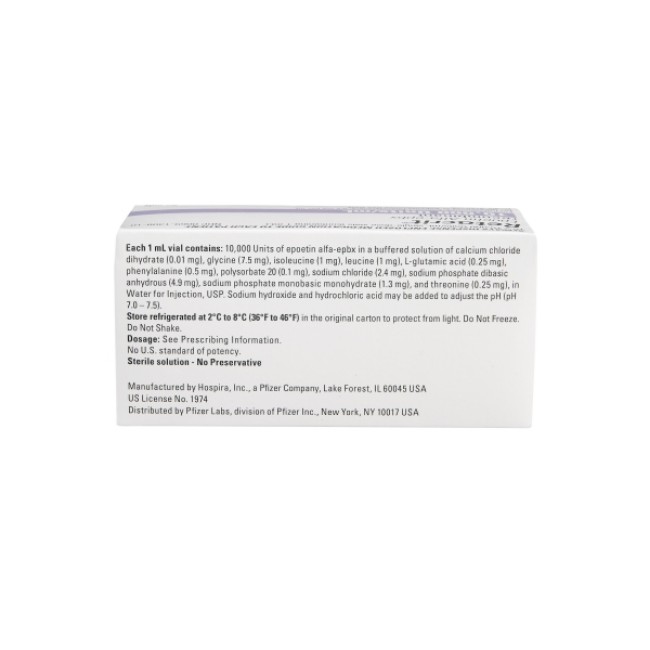
Epoetin alfa-epbx is an erythropoiesis-stimulating agent. Epoetin alfa-epbx is a 165-amino acid glycoprotein manufactured by recombinant DNA technology. It has a molecular weight of approximately 30,400 daltons and is produced in Chinese Hamster Ovary (CHO) cell line. The product contains the identical amino acid sequence of isolated natural erythropoietin. RETACRIT (epoetin alfa-epbx) injection for intravenous or subcutaneous administration is a sterile, clear, colorless solution in vials in multiple formulations. Each 1 mL single-dose vial of 2,000, 3,000, 4,000, and 10,000 Units of epoetin alfa-epbx contains calcium chloride dihydrate (0.01 mg), glycine (7.5 mg), isoleucine (1 mg), leucine (1 mg), L-glutamic acid (0.25 mg), phenylalanine (0.5 mg), polysorbate 20 (0.1 mg), sodium chloride (2.4 mg), sodium phosphate dibasic anhydrous (4.9 mg), sodium phosphate monobasic monohydrate (1.3 mg), and threonine (0.25 mg), in Water for Injection, USP. Sodium hydroxide and hydrochloric acid may be added to adjust the pH (pH 7.0 – 7.5). Each 1 mL single-dose vial of 40,000 Units of epoetin alfa-epbx contains calcium chloride dihydrate (0.01 mg), glycine (7.5 mg), isoleucine (1 mg), leucine (1 mg), L-glutamic acid (0.25 mg), phenylalanine (0.5 mg), polysorbate 20 (0.1 mg), sodium chloride (2.2 mg), sodium phosphate dibasic anhydrous (5.7 mg), sodium phosphate monobasic monohydrate (1.5 mg), and threonine (0.25 mg), in Water for Injection, USP. Sodium hydroxide and hydrochloric acid may be added to adjust the pH (pH 7.0 – 7.5). Each 1 mL multiple-dose vial of 20,000 Units of epoetin alfa-epbx contains benzyl alcohol (8.5 mg), L-methionine (0.45 mg), polysorbate 20 (0.04 mg), sodium phosphate dibasic anhydrous (0.09 mg), sodium phosphate monobasic monohydrate (2.67 mg), and sucrose (60 mg) in Water for Injection, USP. Sodium hydroxide and hydrochloric acid may be added to adjust the pH (pH 5.6 – 6.6). Each 2 mL multiple-dose vial of 20,000 Units (10,000 Units/mL) of epoetin alfa-epbx contains benzyl alcohol (17 mg), L-methionine (0.9 mg), polysorbate 20 (0.08 mg), sodium phosphate dibasic anhydrous (0.18 mg), sodium phosphate monobasic monohydrate (5.34 mg), and sucrose (120 mg) in Water for Injection, USP. Sodium hydroxide and hydrochloric acid may be added to adjust the pH (pH 5.6 – 6.6).
Product Properties:
| Description | Retacrit inj esrd on dialysis, 100 units |
|---|---|
| Description | - |
| Description | - |
| DESI Drug Ind | - |
| DESI Drug Ind | - |
| DESI Drug Ind | - |
| DESI2 Drug Ind | NR |
| DESI2 Drug Ind | - |
| DESI2 Drug Ind | NR |
| Drug Category | - |
| Drug Category | S |
| Drug Category | - |
| Drug Type Code | S |
| Drug Type Code | 1 |
| Drug Type Code | S |
| FDA Approval Date | 11/08/2018 |
| FDA Approval Date | 05/15/2018 |
| FDA Approval Date | 11/08/2018 |
| FDA Therap Equiv | ML |
| FDA Therap Equiv | NR |
| FDA Therap Equiv | ML |
| HCPCS | Retacrit inj esrd on dialysis, 100 units |
| HCPCS | Retacrit inj esrd on dialysis, 100 units |
| HCPCS | Q5105 |
| Market Entry Date | - |
| Market Entry Date | 11/08/2018 |
| Market Entry Date | - |
| Medical Coverage | Q5105 |
| Medical Coverage | Q5105 |
| Medical Coverage | COVERED WITH SPECIAL INSTRUCTIONS |
| Termination Date | 1 |
| Termination Date | 1 |
| Termination Date | - |
| Unit | ML |
| Unit | 1 |
| Unit | 1 |
| Units Per Pkg | 05/15/2018 |
| Units Per Pkg | 1 |
| Units Per Pkg | 05/15/2018 |
| Active Ingredients | 17553 epoetin alfa-epbx 113427240 |
| Active Ingredients | 17553 epoetin alfa-epbx 113427240 |
| Active Ingredients | 17553 epoetin alfa-epbx 113427240 |
| AHFS Class | 20160000 HEMATOPOIETIC AGENTS |
| AHFS Class | 20160000 HEMATOPOIETIC AGENTS |
| AHFS Class | 20160000 HEMATOPOIETIC AGENTS |
| DEA Class | NC |
| DEA Class | NC |
| DEA Class | NC |
| Dose Form | VIAL (ML) |
| Dose Form | VIAL (ML) |
| Dose Form | VIAL (ML) |
| Fine Line Class | 850085008510 All Rx Products |
| Fine Line Class | 850085008510 All Rx Products |
| Fine Line Class | 850085008510 All Rx Products |
| Gen Code and Des | 78435 epoetin alfa-epbx INJECTION VIAL 10000/ML |
| Gen Code and Des | 78435 epoetin alfa-epbx INJECTION VIAL 10000/ML |
| Gen Code and Des | 78435 epoetin alfa-epbx INJECTION VIAL 10000/ML |
| Inactive Ingredients | 18822 rubber, unspecified; 2551 polysorbates 9005645; 3542 phenylalanine 63912 |
| Inactive Ingredients | 18822 rubber, unspecified; 2551 polysorbates 9005645; 3542 phenylalanine 63912 |
| Inactive Ingredients | 18822 rubber, unspecified; 2551 polysorbates 9005645; 3542 phenylalanine 63912 |
| OMP Family | - |
| OMP Family | - |
| OMP Family | - |
| Product Category | RX Pharmaceuticals |
| Product Category | RX Pharmaceuticals |
| Product Category | RX Pharmaceuticals |
| Strength | 10MU |
| Strength | 10MU |
| Strength | 10MU |
| Common Brand Name | COMMON BRAND NAME(S): Epogen, Procrit, Retacrit |
| Common Brand Name | COMMON BRAND NAME(S): Epogen, Procrit, Retacrit |
| Common Brand Name | COMMON BRAND NAME(S): Epogen, Procrit, Retacrit |
| Drug Interaction | DRUG INTERACTIONS: Drug interactions may change how your medications work or increase your risk for serious side effects. This document does not contain all possible drug interactions. Keep a list of all the products you use (including prescription/nonprescription drugs and herbal products) and share it with your doctor and pharmacist. Do not start, stop, or change the dosage of any medicines without your doctor's approval. |
| Drug Interaction | DRUG INTERACTIONS: Drug interactions may change how your medications work or increase your risk for serious side effects. This document does not contain all possible drug interactions. Keep a list of all the products you use (including prescription/nonprescription drugs and herbal products) and share it with your doctor and pharmacist. Do not start, stop, or change the dosage of any medicines without your doctor's approval. |
| Drug Interaction | DRUG INTERACTIONS: Drug interactions may change how your medications work or increase your risk for serious side effects. This document does not contain all possible drug interactions. Keep a list of all the products you use (including prescription/nonprescription drugs and herbal products) and share it with your doctor and pharmacist. Do not start, stop, or change the dosage of any medicines without your doctor's approval. |
| Allocation Period | Weekly |
| Allocation Period | Weekly |
| Allocation Period | Weekly |
| Case Quantity | 10 |
| Case Quantity | 10 |
| Case Quantity | 10 |
| Drug Form Pack Size | 10 |
| Drug Form Pack Size | 10 |
| Drug Form Pack Size | 10 |
| Form | VIAL |
| Form | VIAL |
| Form | VIAL |
| Hazard Code | - |
| Hazard Code | - |
| Hazard Code | - |
| Listed Chemical | - |
| Listed Chemical | - |
| Listed Chemical | - |
| NIOSH Code | - |
| NIOSH Code | - |
| NIOSH Code | - |
| Orange Book | ZB Particular pharmaceutical entity was not evaluated. |
| Orange Book | ZB Particular pharmaceutical entity was not evaluated. |
| Orange Book | ZB Particular pharmaceutical entity was not evaluated. |
| Retail Pack Quantity | 1 |
| Retail Pack Quantity | 1 |
| Retail Pack Quantity | 1 |
| Returnable Status | Returnable |
| Returnable Status | Returnable |
| Returnable Status | Returnable |
| Special Storage Cond | 00 None |
| Special Storage Cond | 00 None |
| Special Storage Cond | 00 None |
| Temp Zone | 30 Refrige./DoNot Freez |
| Temp Zone | 30 Refrige./DoNot Freez |
| Temp Zone | 30 Refrige./DoNot Freez |
| Unit | PK |
| Unit | PK |
| Unit | PK |
| Unit Size | 10X1 |
| Unit Size | 10X1 |
| Unit Size | 10X1 |
| How to Use | HOW TO USE: Read the Medication Guide and Patient Information Leaflet provided by your pharmacist before you start using this medication and each time you get a refill. If you have any questions, ask your doctor or pharmacist. This medication is given as an injection under the skin or into a vein as directed by your doctor, usually 1 to 3 times a week. Patients getting this medication before surgery may have a special dosing schedule. Hemodialysis patients should receive this medication by injection into a vein. If you are using this medication at home, learn all preparation and usage instructions from your health care professional. Do not shake this medication. Before using, check this product visually for particles or discoloration. If either is present, do not use the liquid. If you are injecting this medication under the skin, before each dose, clean the injection site with rubbing alcohol. Do not inject into an area of skin that is tender, red, bruised, hard, or has scars or stretch marks. Recommended injection sites include the upper arms, abdomen, front of the middle thighs, or upper outer area of the buttocks. Change the injection site each time to lessen injury under the skin. Learn how to store and discard medical supplies safely. The dosage is based on your medical condition, weight, and response to treatment. Blood tests should be done often to check how well this medication is working and to decide the correct dose for you. Consult your doctor for more details. Use this medication regularly to get the most benefit from it. To help you remember, use it on the same day(s) of the week as directed. Do not increase your dose or use this drug more often or for longer than prescribed. Your condition will not improve any faster, and your risk of side effects will increase. It may take 2 to 6 weeks before your red blood cell count increases. Tell your doctor if your symptoms do not get better or if they get worse. |
| How to Use | HOW TO USE: Read the Medication Guide and Patient Information Leaflet provided by your pharmacist before you start using this medication and each time you get a refill. If you have any questions, ask your doctor or pharmacist. This medication is given as an injection under the skin or into a vein as directed by your doctor, usually 1 to 3 times a week. Patients getting this medication before surgery may have a special dosing schedule. Hemodialysis patients should receive this medication by injection into a vein. If you are using this medication at home, learn all preparation and usage instructions from your health care professional. Do not shake this medication. Before using, check this product visually for particles or discoloration. If either is present, do not use the liquid. If you are injecting this medication under the skin, before each dose, clean the injection site with rubbing alcohol. Do not inject into an area of skin that is tender, red, bruised, hard, or has scars or stretch marks. Recommended injection sites include the upper arms, abdomen, front of the middle thighs, or upper outer area of the buttocks. Change the injection site each time to lessen injury under the skin. Learn how to store and discard medical supplies safely. The dosage is based on your medical condition, weight, and response to treatment. Blood tests should be done often to check how well this medication is working and to decide the correct dose for you. Consult your doctor for more details. Use this medication regularly to get the most benefit from it. To help you remember, use it on the same day(s) of the week as directed. Do not increase your dose or use this drug more often or for longer than prescribed. Your condition will not improve any faster, and your risk of side effects will increase. It may take 2 to 6 weeks before your red blood cell count increases. Tell your doctor if your symptoms do not get better or if they get worse. |
| How to Use | HOW TO USE: Read the Medication Guide and Patient Information Leaflet provided by your pharmacist before you start using this medication and each time you get a refill. If you have any questions, ask your doctor or pharmacist. This medication is given as an injection under the skin or into a vein as directed by your doctor, usually 1 to 3 times a week. Patients getting this medication before surgery may have a special dosing schedule. Hemodialysis patients should receive this medication by injection into a vein. If you are using this medication at home, learn all preparation and usage instructions from your health care professional. Do not shake this medication. Before using, check this product visually for particles or discoloration. If either is present, do not use the liquid. If you are injecting this medication under the skin, before each dose, clean the injection site with rubbing alcohol. Do not inject into an area of skin that is tender, red, bruised, hard, or has scars or stretch marks. Recommended injection sites include the upper arms, abdomen, front of the middle thighs, or upper outer area of the buttocks. Change the injection site each time to lessen injury under the skin. Learn how to store and discard medical supplies safely. The dosage is based on your medical condition, weight, and response to treatment. Blood tests should be done often to check how well this medication is working and to decide the correct dose for you. Consult your doctor for more details. Use this medication regularly to get the most benefit from it. To help you remember, use it on the same day(s) of the week as directed. Do not increase your dose or use this drug more often or for longer than prescribed. Your condition will not improve any faster, and your risk of side effects will increase. It may take 2 to 6 weeks before your red blood cell count increases. Tell your doctor if your symptoms do not get better or if they get worse. |
| Missed Dose | MISSED DOSE: If you miss a dose, ask your doctor or pharmacist right away for a new dosing schedule. Do not double the dose to catch up. |
| Missed Dose | MISSED DOSE: If you miss a dose, ask your doctor or pharmacist right away for a new dosing schedule. Do not double the dose to catch up. |
| Missed Dose | MISSED DOSE: If you miss a dose, ask your doctor or pharmacist right away for a new dosing schedule. Do not double the dose to catch up. |
| Notes | NOTES: Do not share this medication with others. Lab and/or medical tests (such as blood pressure, complete blood count that includes hemoglobin level) should be done while you are using this medication. Keep all medical and lab appointments. Consult your doctor for more details. Blood tests for your iron levels will also be done and you may be prescribed iron supplements to take. Your doctor may recommend that you eat a well-balanced diet rich in iron (such as raisins, figs, meat, eggs, vegetables, iron-fortified cereals). Follow your doctor's instructions and dietary recommendations. |
| Notes | NOTES: Do not share this medication with others. Lab and/or medical tests (such as blood pressure, complete blood count that includes hemoglobin level) should be done while you are using this medication. Keep all medical and lab appointments. Consult your doctor for more details. Blood tests for your iron levels will also be done and you may be prescribed iron supplements to take. Your doctor may recommend that you eat a well-balanced diet rich in iron (such as raisins, figs, meat, eggs, vegetables, iron-fortified cereals). Follow your doctor's instructions and dietary recommendations. |
| Notes | NOTES: Do not share this medication with others. Lab and/or medical tests (such as blood pressure, complete blood count that includes hemoglobin level) should be done while you are using this medication. Keep all medical and lab appointments. Consult your doctor for more details. Blood tests for your iron levels will also be done and you may be prescribed iron supplements to take. Your doctor may recommend that you eat a well-balanced diet rich in iron (such as raisins, figs, meat, eggs, vegetables, iron-fortified cereals). Follow your doctor's instructions and dietary recommendations. |
| Overdose | OVERDOSE: If someone has overdosed and has serious symptoms such as passing out or trouble breathing, call 911. Otherwise, call a poison control center right away. US residents can call their local poison control center at 1-800-222-1222. Canada residents can call a provincial poison control center. |
| Overdose | OVERDOSE: If someone has overdosed and has serious symptoms such as passing out or trouble breathing, call 911. Otherwise, call a poison control center right away. US residents can call their local poison control center at 1-800-222-1222. Canada residents can call a provincial poison control center. |
| Overdose | OVERDOSE: If someone has overdosed and has serious symptoms such as passing out or trouble breathing, call 911. Otherwise, call a poison control center right away. US residents can call their local poison control center at 1-800-222-1222. Canada residents can call a provincial poison control center. |
| Phonetic Pronunciation | (e-POE-tin AL-fa) |
| Phonetic Pronunciation | (e-POE-tin AL-fa) |
| Phonetic Pronunciation | (e-POE-tin AL-fa) |
| Precautions | PRECAUTIONS: Before using epoetin alfa, tell your doctor or pharmacist if you are allergic to it; or to any epoetin alfa products; or to other drugs that cause more red blood cells to be made (such as darbepoetin alfa); or if you have any other allergies. This product may contain inactive ingredients (such as benzyl alcohol), which can cause allergic reactions or other problems. Talk to your pharmacist for more details. Before using this medication, tell your doctor or pharmacist your medical history, especially of: high blood pressure, heart disease (such as heart failure, past heart attack/stroke), seizure disorder, severe anemia caused by antibodies to past erythropoietin-type treatment (pure red cell aplasia). Some forms of this medication are made from human blood. Even though the blood is carefully tested, and this medication goes through a special manufacturing process, there is an extremely small chance that you may get infections from the medication (for example, viruses such as hepatitis). Consult your doctor or pharmacist for more information. This medication may contain phenylalanine. If you have phenylketonuria (PKU) or any other condition that requires you to limit/avoid phenylalanine (or aspartame) in your diet, ask your doctor or pharmacist about using this medication safely. Before having surgery, tell your doctor or dentist about all the products you use (including prescription drugs, nonprescription drugs, and herbal products). During pregnancy, this medication should be used only when clearly needed. Discuss the risks and benefits with your doctor. It is unknown if this medication passes into breast milk. Consult your doctor before breast-feeding. |
| Precautions | PRECAUTIONS: Before using epoetin alfa, tell your doctor or pharmacist if you are allergic to it; or to any epoetin alfa products; or to other drugs that cause more red blood cells to be made (such as darbepoetin alfa); or if you have any other allergies. This product may contain inactive ingredients (such as benzyl alcohol), which can cause allergic reactions or other problems. Talk to your pharmacist for more details. Before using this medication, tell your doctor or pharmacist your medical history, especially of: high blood pressure, heart disease (such as heart failure, past heart attack/stroke), seizure disorder, severe anemia caused by antibodies to past erythropoietin-type treatment (pure red cell aplasia). Some forms of this medication are made from human blood. Even though the blood is carefully tested, and this medication goes through a special manufacturing process, there is an extremely small chance that you may get infections from the medication (for example, viruses such as hepatitis). Consult your doctor or pharmacist for more information. This medication may contain phenylalanine. If you have phenylketonuria (PKU) or any other condition that requires you to limit/avoid phenylalanine (or aspartame) in your diet, ask your doctor or pharmacist about using this medication safely. Before having surgery, tell your doctor or dentist about all the products you use (including prescription drugs, nonprescription drugs, and herbal products). During pregnancy, this medication should be used only when clearly needed. Discuss the risks and benefits with your doctor. It is unknown if this medication passes into breast milk. Consult your doctor before breast-feeding. |
| Precautions | PRECAUTIONS: Before using epoetin alfa, tell your doctor or pharmacist if you are allergic to it; or to any epoetin alfa products; or to other drugs that cause more red blood cells to be made (such as darbepoetin alfa); or if you have any other allergies. This product may contain inactive ingredients (such as benzyl alcohol), which can cause allergic reactions or other problems. Talk to your pharmacist for more details. Before using this medication, tell your doctor or pharmacist your medical history, especially of: high blood pressure, heart disease (such as heart failure, past heart attack/stroke), seizure disorder, severe anemia caused by antibodies to past erythropoietin-type treatment (pure red cell aplasia). Some forms of this medication are made from human blood. Even though the blood is carefully tested, and this medication goes through a special manufacturing process, there is an extremely small chance that you may get infections from the medication (for example, viruses such as hepatitis). Consult your doctor or pharmacist for more information. This medication may contain phenylalanine. If you have phenylketonuria (PKU) or any other condition that requires you to limit/avoid phenylalanine (or aspartame) in your diet, ask your doctor or pharmacist about using this medication safely. Before having surgery, tell your doctor or dentist about all the products you use (including prescription drugs, nonprescription drugs, and herbal products). During pregnancy, this medication should be used only when clearly needed. Discuss the risks and benefits with your doctor. It is unknown if this medication passes into breast milk. Consult your doctor before breast-feeding. |
| Side Effects | SIDE EFFECTS: Headache, body aches, cough, or injection site irritation/pain may occur. If any of these effects last or get worse, tell your doctor or pharmacist promptly. Remember that this medication has been prescribed because your doctor has judged that the benefit to you is greater than the risk of side effects. Many people using this medication do not have serious side effects. Epoetin alfa may sometimes cause or worsen high blood pressure, especially in patients with long-term kidney failure. This effect may be caused by the number of red blood cells increasing too quickly, usually within the first 3 months of starting treatment. If you have high blood pressure, it should be well controlled before beginning treatment with this medication. Your blood pressure should be checked often. Ask your doctor if you should learn how to check your own blood pressure. If high blood pressure develops or worsens, follow your doctor's instructions about diet changes and starting or adjusting your high blood pressure medication. Lowering high blood pressure helps prevent strokes, heart attacks, and further kidney problems. Keep all lab appointments to have your red blood cell count/hemoglobin level tested regularly to reduce the chance of this side effect. Rarely, this medication may suddenly stop working well after a period of time because your body may make antibodies to it. A very serious anemia can result. Tell your doctor right away if symptoms of anemia return (such as increased tiredness, low energy, pale skin color, shortness of breath). Tell your doctor right away if you have any serious side effects, including: symptoms of heart failure (such as shortness of breath, swelling ankles/feet, unusual tiredness, unusual/sudden weight gain). Get medical help right away if you have any very serious side effects, including: seizures. This medication may rarely cause serious (sometimes fatal) problems from blood clots (such as heart attack, stroke, blood clots in the legs or lungs). You may be at increased risk for blood clots if you are severely dehydrated, or have a history of blood clots, heart/blood vessel disease, heart failure, stroke, pregnant, or if you are immobile (such as on very long plane flights or being bedridden). If you use estrogen-containing products, these may also increase your risk. Before using this medication, if you have any of these conditions report them to your doctor or pharmacist. Get medical help right away if you have: shortness of breath/rapid breathing, chest/jaw/left arm pain, unusual sweating, confusion, sudden dizziness/fainting, pain/swelling/warmth in the groin/calf, sudden/severe headaches, trouble speaking, weakness on one side of the body, sudden vision changes, blood clots in your hemodialysis vascular access site. A very serious allergic reaction to this drug is rare. However, get medical help right away if you notice any symptoms of a serious allergic reaction, including: rash, itching/swelling (especially of the face/tongue/throat), severe dizziness, trouble breathing. This is not a complete list of possible side effects. If you notice other effects not listed above, contact your doctor or pharmacist. In the US - Call your doctor for medical advice about side effects. You may report side effects to FDA at 1-800-FDA-1088 or at www.fda.gov/medwatch. In Canada - Call your doctor for medical advice about side effects. You may report side effects to Health Canada at 1-866-234-2345. |
| Side Effects | SIDE EFFECTS: Headache, body aches, cough, or injection site irritation/pain may occur. If any of these effects last or get worse, tell your doctor or pharmacist promptly. Remember that this medication has been prescribed because your doctor has judged that the benefit to you is greater than the risk of side effects. Many people using this medication do not have serious side effects. Epoetin alfa may sometimes cause or worsen high blood pressure, especially in patients with long-term kidney failure. This effect may be caused by the number of red blood cells increasing too quickly, usually within the first 3 months of starting treatment. If you have high blood pressure, it should be well controlled before beginning treatment with this medication. Your blood pressure should be checked often. Ask your doctor if you should learn how to check your own blood pressure. If high blood pressure develops or worsens, follow your doctor's instructions about diet changes and starting or adjusting your high blood pressure medication. Lowering high blood pressure helps prevent strokes, heart attacks, and further kidney problems. Keep all lab appointments to have your red blood cell count/hemoglobin level tested regularly to reduce the chance of this side effect. Rarely, this medication may suddenly stop working well after a period of time because your body may make antibodies to it. A very serious anemia can result. Tell your doctor right away if symptoms of anemia return (such as increased tiredness, low energy, pale skin color, shortness of breath). Tell your doctor right away if you have any serious side effects, including: symptoms of heart failure (such as shortness of breath, swelling ankles/feet, unusual tiredness, unusual/sudden weight gain). Get medical help right away if you have any very serious side effects, including: seizures. This medication may rarely cause serious (sometimes fatal) problems from blood clots (such as heart attack, stroke, blood clots in the legs or lungs). You may be at increased risk for blood clots if you are severely dehydrated, or have a history of blood clots, heart/blood vessel disease, heart failure, stroke, pregnant, or if you are immobile (such as on very long plane flights or being bedridden). If you use estrogen-containing products, these may also increase your risk. Before using this medication, if you have any of these conditions report them to your doctor or pharmacist. Get medical help right away if you have: shortness of breath/rapid breathing, chest/jaw/left arm pain, unusual sweating, confusion, sudden dizziness/fainting, pain/swelling/warmth in the groin/calf, sudden/severe headaches, trouble speaking, weakness on one side of the body, sudden vision changes, blood clots in your hemodialysis vascular access site. A very serious allergic reaction to this drug is rare. However, get medical help right away if you notice any symptoms of a serious allergic reaction, including: rash, itching/swelling (especially of the face/tongue/throat), severe dizziness, trouble breathing. This is not a complete list of possible side effects. If you notice other effects not listed above, contact your doctor or pharmacist. In the US - Call your doctor for medical advice about side effects. You may report side effects to FDA at 1-800-FDA-1088 or at www.fda.gov/medwatch. In Canada - Call your doctor for medical advice about side effects. You may report side effects to Health Canada at 1-866-234-2345. |
| Side Effects | SIDE EFFECTS: Headache, body aches, cough, or injection site irritation/pain may occur. If any of these effects last or get worse, tell your doctor or pharmacist promptly. Remember that this medication has been prescribed because your doctor has judged that the benefit to you is greater than the risk of side effects. Many people using this medication do not have serious side effects. Epoetin alfa may sometimes cause or worsen high blood pressure, especially in patients with long-term kidney failure. This effect may be caused by the number of red blood cells increasing too quickly, usually within the first 3 months of starting treatment. If you have high blood pressure, it should be well controlled before beginning treatment with this medication. Your blood pressure should be checked often. Ask your doctor if you should learn how to check your own blood pressure. If high blood pressure develops or worsens, follow your doctor's instructions about diet changes and starting or adjusting your high blood pressure medication. Lowering high blood pressure helps prevent strokes, heart attacks, and further kidney problems. Keep all lab appointments to have your red blood cell count/hemoglobin level tested regularly to reduce the chance of this side effect. Rarely, this medication may suddenly stop working well after a period of time because your body may make antibodies to it. A very serious anemia can result. Tell your doctor right away if symptoms of anemia return (such as increased tiredness, low energy, pale skin color, shortness of breath). Tell your doctor right away if you have any serious side effects, including: symptoms of heart failure (such as shortness of breath, swelling ankles/feet, unusual tiredness, unusual/sudden weight gain). Get medical help right away if you have any very serious side effects, including: seizures. This medication may rarely cause serious (sometimes fatal) problems from blood clots (such as heart attack, stroke, blood clots in the legs or lungs). You may be at increased risk for blood clots if you are severely dehydrated, or have a history of blood clots, heart/blood vessel disease, heart failure, stroke, pregnant, or if you are immobile (such as on very long plane flights or being bedridden). If you use estrogen-containing products, these may also increase your risk. Before using this medication, if you have any of these conditions report them to your doctor or pharmacist. Get medical help right away if you have: shortness of breath/rapid breathing, chest/jaw/left arm pain, unusual sweating, confusion, sudden dizziness/fainting, pain/swelling/warmth in the groin/calf, sudden/severe headaches, trouble speaking, weakness on one side of the body, sudden vision changes, blood clots in your hemodialysis vascular access site. A very serious allergic reaction to this drug is rare. However, get medical help right away if you notice any symptoms of a serious allergic reaction, including: rash, itching/swelling (especially of the face/tongue/throat), severe dizziness, trouble breathing. This is not a complete list of possible side effects. If you notice other effects not listed above, contact your doctor or pharmacist. In the US - Call your doctor for medical advice about side effects. You may report side effects to FDA at 1-800-FDA-1088 or at www.fda.gov/medwatch. In Canada - Call your doctor for medical advice about side effects. You may report side effects to Health Canada at 1-866-234-2345. |
| Storage | STORAGE: Store in the refrigerator. Do not freeze. Protect from light. Store the medication in the original carton until ready for use. For the single-use vials, discard any unused medication right away. For the multi-use vials, store opened vials in the refrigerator and discard any unused medication after 3 weeks. Keep all medications away from children and pets. Do not flush medications down the toilet or pour them into a drain unless instructed to do so. Properly discard this product when it is expired or no longer needed. Consult your pharmacist or local waste disposal company. |
| Storage | STORAGE: Store in the refrigerator. Do not freeze. Protect from light. Store the medication in the original carton until ready for use. For the single-use vials, discard any unused medication right away. For the multi-use vials, store opened vials in the refrigerator and discard any unused medication after 3 weeks. Keep all medications away from children and pets. Do not flush medications down the toilet or pour them into a drain unless instructed to do so. Properly discard this product when it is expired or no longer needed. Consult your pharmacist or local waste disposal company. |
| Storage | STORAGE: Store in the refrigerator. Do not freeze. Protect from light. Store the medication in the original carton until ready for use. For the single-use vials, discard any unused medication right away. For the multi-use vials, store opened vials in the refrigerator and discard any unused medication after 3 weeks. Keep all medications away from children and pets. Do not flush medications down the toilet or pour them into a drain unless instructed to do so. Properly discard this product when it is expired or no longer needed. Consult your pharmacist or local waste disposal company. |
| Uses | USES: This medication is used to treat anemia (low red blood cell count) in people with long-term serious kidney disease (chronic kidney failure), people receiving zidovudine to treat HIV, and people receiving chemotherapy for some types of cancer (cancer that does not involve the bone marrow or blood cells). It may also be used in anemic patients to reduce the need for blood transfusions before certain planned surgeries that have a high risk of blood loss (usually given with an anticoagulant/"blood thinner" medication such as warfarin to lower the risk of serious blood clots). Epoetin alfa works by signaling the bone marrow to make more red blood cells. This medication is very similar to the natural substance in your body (erythropoietin) that prevents anemia. This monograph is about the following epoetin alfa products: epoetin alfa and epoetin alfa-epbx. |
| Uses | USES: This medication is used to treat anemia (low red blood cell count) in people with long-term serious kidney disease (chronic kidney failure), people receiving zidovudine to treat HIV, and people receiving chemotherapy for some types of cancer (cancer that does not involve the bone marrow or blood cells). It may also be used in anemic patients to reduce the need for blood transfusions before certain planned surgeries that have a high risk of blood loss (usually given with an anticoagulant/"blood thinner" medication such as warfarin to lower the risk of serious blood clots). Epoetin alfa works by signaling the bone marrow to make more red blood cells. This medication is very similar to the natural substance in your body (erythropoietin) that prevents anemia. This monograph is about the following epoetin alfa products: epoetin alfa and epoetin alfa-epbx. |
| Uses | USES: This medication is used to treat anemia (low red blood cell count) in people with long-term serious kidney disease (chronic kidney failure), people receiving zidovudine to treat HIV, and people receiving chemotherapy for some types of cancer (cancer that does not involve the bone marrow or blood cells). It may also be used in anemic patients to reduce the need for blood transfusions before certain planned surgeries that have a high risk of blood loss (usually given with an anticoagulant/"blood thinner" medication such as warfarin to lower the risk of serious blood clots). Epoetin alfa works by signaling the bone marrow to make more red blood cells. This medication is very similar to the natural substance in your body (erythropoietin) that prevents anemia. This monograph is about the following epoetin alfa products: epoetin alfa and epoetin alfa-epbx. |
Frequently Asked Questions (FAQs)
The cost of RETACRIT 10000U/ML 1ML SDV 10/PAC is $available for registerd members only
RETACRIT 10000U/ML 1ML SDV 10/PAC is manufactured by Pfizer.
You can purchase RETACRIT 10000U/ML 1ML SDV 10/PAC on our website at https://supplies.pipelinemedical.com/product/detail/retacrit-10000-un-ml-vl-10x1ml-323428