
Product Details
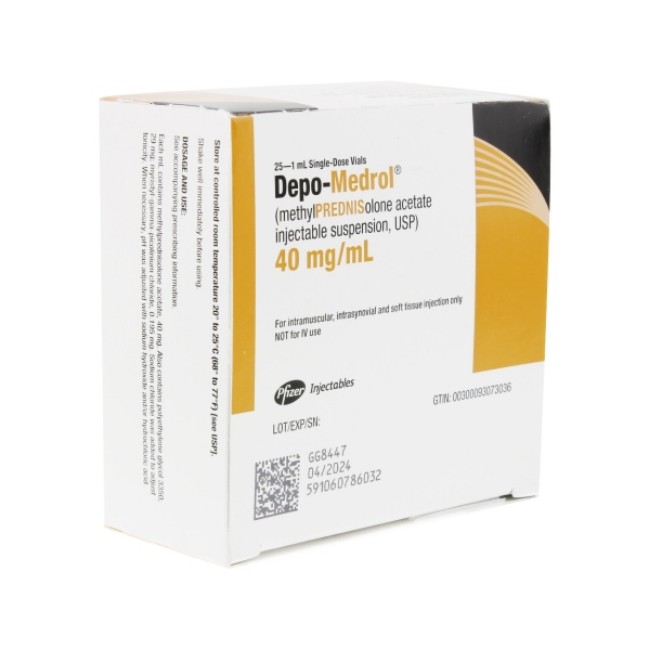
25/BX
$ *.**
Limited Quantities25/CT
$204.93
In StockAdditional Information
| Product Name | Depo-Medrol SDV 40mg/mL 1mL |
| Application | Corticosteroid |
| Generic Drug Name | Methylprednisolone Acetate |
| Mechanism of Action | Suppresses inflammation by inhibiting leukocyte function and production of cytokines |
| Strength | 40 mg / mL |
| Volume | 1 mL |
| Administration Route | Intramuscular, intra-articular, soft tissue, intralesional |
| Onset of Action | 1-2 days (IM) |
| Half-Life | 18-36 hours |
| Duration of Action | Prolonged due to depot formulation |
| Common Side Effects | Injection site pain, weight gain, mood changes |
| Drug Interactions | May interact with NSAIDs, anticoagulants, diuretics |
| Reconstitution | Ready-to-use, no reconstitution needed |
| Container Type | Single-Dose Vial |
| Indications | Arthritis, bursitis, tendonitis, allergic conditions |
Description
Depo-Medrol SDV 40mg/mL 1mL is a sterile aqueous suspension of methylprednisolone acetate, a potent anti-inflammatory glucocorticoid. It is designed for injection into specific sites including intramuscular, intra-articular, soft tissue, or intralesional areas. This formulation is not intended for intravenous administration.
Methylprednisolone acetate works by inhibiting the release of substances in the body that cause inflammation. It exerts its therapeutic effects through the suppression of immune system activity and reduction of inflammation. Depo-Medrol is commonly used to manage conditions such as arthritis, bursitis, tendinitis, and allergic reactions involving the skin, eyes, or respiratory system.
The product provides prolonged action due to its depot formulation, which slowly releases the active ingredient over time, ensuring sustained anti-inflammatory effects. It is typically administered by healthcare professionals in clinical settings, with doses tailored to the severity of the condition being treated.
Product Properties:
| Description | Methylprednisolone inj, 40 MG |
|---|---|
| Description | - |
| DESI Drug Ind | - |
| DESI Drug Ind | - |
| DESI2 Drug Ind | - |
| DESI2 Drug Ind | AB |
| Drug Category | NJ |
| Drug Category | I |
| Drug Type Code | 1 |
| Drug Type Code | I |
| FDA Approval Date | 12/10/1991 |
| FDA Approval Date | 12/01/1991 |
| FDA Therap Equiv | ML |
| FDA Therap Equiv | AB |
| HCPCS | Methylprednisolone inj, 40 MG |
| HCPCS | J1030 |
| Market Entry Date | 12/10/1991 |
| Market Entry Date | - |
| Medical Coverage | J1030 |
| Medical Coverage | COVERED WITH SPECIAL INSTRUCTIONS |
| Termination Date | 1 |
| Termination Date | - |
| Unit | ML |
| Unit | 1 |
| Units Per Pkg | 12/01/1991 |
| Units Per Pkg | 1 |
| Active Ingredients | 2161 methylprednisolone acetate 53361 |
| Active Ingredients | 2161 methylprednisolone acetate 53361 |
| AHFS Class | 68040000 ADRENALS |
| AHFS Class | 68040000 ADRENALS |
| DEA Class | NC |
| DEA Class | NC |
| Dose Form | VIAL (ML) |
| Dose Form | VIAL (ML) |
| Fine Line Class | 850085008510 All Rx Products |
| Fine Line Class | 850085008510 All Rx Products |
| Gen Code and Des | 6724 methylprednisolone acetate INJECTION VIAL 40 MG/ML |
| Gen Code and Des | 6724 methylprednisolone acetate INJECTION VIAL 40 MG/ML |
| Inactive Ingredients | - |
| Inactive Ingredients | - |
| OMP Family | - |
| OMP Family | - |
| Product Category | RX Pharmaceuticals |
| Product Category | RX Pharmaceuticals |
| Strength | 40MG |
| Strength | 40MG |
| Common Brand Name | COMMON BRAND NAME(S): Depo-Medrol |
| Common Brand Name | COMMON BRAND NAME(S): Depo-Medrol |
| Drug Interaction | DRUG INTERACTIONS: Drug interactions may change how your medications work or increase your risk for serious side effects. This document does not contain all possible drug interactions. Keep a list of all the products you use (including prescription/nonprescription drugs and herbal products) and share it with your doctor and pharmacist. Do not start, stop, or change the dosage of any medicines without your doctor's approval. Some products that may interact with this drug include: aldesleukin, mifepristone, other drugs that can also cause bleeding/bruising (including antiplatelet drugs such as clopidogrel, "blood thinners" such as warfarin/dabigatran, NSAIDs such as ibuprofen, celecoxib, aspirin, salicylates). If your doctor has directed you to take low-dose aspirin for heart attack or stroke prevention (usually 81-162 milligrams a day), you should continue taking it unless your doctor instructs you otherwise. Ask your doctor or pharmacist for more details. Other medications can affect the removal of methylprednisolone from your body, which may affect how methylprednisolone works. Examples include azole antifungals (such as ketoconazole), cyclosporine, estrogens, HIV protease inhibitors (such as darunavir), macrolide antibiotics (such as erythromycin), ritonavir, St. John's wort, some drugs used to treat seizures (such as phenytoin, phenobarbital), among others. This medication may interfere with certain laboratory tests (including skin tests), possibly causing false test results. Make sure laboratory personnel and all your doctors know you use this drug. |
| Drug Interaction | DRUG INTERACTIONS: Drug interactions may change how your medications work or increase your risk for serious side effects. This document does not contain all possible drug interactions. Keep a list of all the products you use (including prescription/nonprescription drugs and herbal products) and share it with your doctor and pharmacist. Do not start, stop, or change the dosage of any medicines without your doctor's approval. Some products that may interact with this drug include: aldesleukin, mifepristone, other drugs that can also cause bleeding/bruising (including antiplatelet drugs such as clopidogrel, "blood thinners" such as warfarin/dabigatran, NSAIDs such as ibuprofen, celecoxib, aspirin, salicylates). If your doctor has directed you to take low-dose aspirin for heart attack or stroke prevention (usually 81-162 milligrams a day), you should continue taking it unless your doctor instructs you otherwise. Ask your doctor or pharmacist for more details. Other medications can affect the removal of methylprednisolone from your body, which may affect how methylprednisolone works. Examples include azole antifungals (such as ketoconazole), cyclosporine, estrogens, HIV protease inhibitors (such as darunavir), macrolide antibiotics (such as erythromycin), ritonavir, St. John's wort, some drugs used to treat seizures (such as phenytoin, phenobarbital), among others. This medication may interfere with certain laboratory tests (including skin tests), possibly causing false test results. Make sure laboratory personnel and all your doctors know you use this drug. |
| Allocation Period | - |
| Allocation Period | - |
| Case Quantity | 12 |
| Case Quantity | 12 |
| Drug Form Pack Size | 25 |
| Drug Form Pack Size | 25 |
| Form | SINGLE DOSE VIAL |
| Form | SINGLE DOSE VIAL |
| Hazard Code | - |
| Hazard Code | - |
| Listed Chemical | - |
| Listed Chemical | - |
| NIOSH Code | - |
| NIOSH Code | - |
| Orange Book | AB Products meeting necessary bioequivalence requirements. |
| Orange Book | AB Products meeting necessary bioequivalence requirements. |
| Retail Pack Quantity | 1 |
| Retail Pack Quantity | 1 |
| Returnable Status | Returnable |
| Returnable Status | Returnable |
| Special Storage Cond | 00 None |
| Special Storage Cond | 00 None |
| Temp Zone | 10 Room Temperature |
| Temp Zone | 10 Room Temperature |
| Unit | EA |
| Unit | EA |
| Unit Size | 25X1 |
| Unit Size | 25X1 |
| How to Use | HOW TO USE: Shake this medication well before using. This medication is usually injected into a joint as directed by your doctor. Methylprednisolone may also be injected into a muscle or into abnormal skin tissue. Follow your doctor's directions carefully. The dosage is based on your medical condition and response to treatment. Do not increase your dose or use this drug more often than prescribed without consulting your doctor. Your condition will not improve any faster, and your risk of side effects will increase. If you are using this medication at home, learn all preparation and usage instructions from your health care professional. This medication should appear milky white. Before using, check this product visually for particles or discoloration. If either is present, do not use the liquid. Learn how to store and discard medical supplies safely. If this medication is injected into a joint, be careful how much pressure you put on that joint, even if it is feeling better. Ask your doctor how much you can move/use the joint while it is healing. Do not stop using this medication without consulting your doctor. Some conditions may become worse when this drug is suddenly stopped. Your dose may need to be gradually decreased. If you suddenly stop using this medication, you may have withdrawal symptoms (such as weakness, weight loss, nausea, muscle pain, headache, tiredness, dizziness). To help prevent withdrawal, your doctor may lower your dose slowly. Withdrawal is more likely if you have used methylprednisolone for a long time or in high doses. Tell your doctor or pharmacist right away if you have withdrawal. See also Precautions section. Tell your doctor if your condition does not improve or if it worsens. |
| How to Use | HOW TO USE: Shake this medication well before using. This medication is usually injected into a joint as directed by your doctor. Methylprednisolone may also be injected into a muscle or into abnormal skin tissue. Follow your doctor's directions carefully. The dosage is based on your medical condition and response to treatment. Do not increase your dose or use this drug more often than prescribed without consulting your doctor. Your condition will not improve any faster, and your risk of side effects will increase. If you are using this medication at home, learn all preparation and usage instructions from your health care professional. This medication should appear milky white. Before using, check this product visually for particles or discoloration. If either is present, do not use the liquid. Learn how to store and discard medical supplies safely. If this medication is injected into a joint, be careful how much pressure you put on that joint, even if it is feeling better. Ask your doctor how much you can move/use the joint while it is healing. Do not stop using this medication without consulting your doctor. Some conditions may become worse when this drug is suddenly stopped. Your dose may need to be gradually decreased. If you suddenly stop using this medication, you may have withdrawal symptoms (such as weakness, weight loss, nausea, muscle pain, headache, tiredness, dizziness). To help prevent withdrawal, your doctor may lower your dose slowly. Withdrawal is more likely if you have used methylprednisolone for a long time or in high doses. Tell your doctor or pharmacist right away if you have withdrawal. See also Precautions section. Tell your doctor if your condition does not improve or if it worsens. |
| Missed Dose | MISSED DOSE: It is important to get each dose of this medication as scheduled. If you miss a dose, ask your doctor or pharmacist right away for a new dosing schedule. Do not double the dose to catch up. |
| Missed Dose | MISSED DOSE: It is important to get each dose of this medication as scheduled. If you miss a dose, ask your doctor or pharmacist right away for a new dosing schedule. Do not double the dose to catch up. |
| Notes | NOTES: Do not share this medication with others. If this medication is used for a long time, lab and/or medical tests (such as blood sugar/mineral levels, blood pressure, eye exams, bone density tests, height/weight measurements) should be done while you are using this medication. Keep all medical and lab appointments. Consult your doctor for more details. Lifestyle changes that help reduce the risk of bone loss (osteoporosis) during long-term treatment include doing weight-bearing exercise, getting adequate calcium and vitamin D, stopping smoking, and limiting alcohol. Consult your doctor for specific advice. |
| Notes | NOTES: Do not share this medication with others. If this medication is used for a long time, lab and/or medical tests (such as blood sugar/mineral levels, blood pressure, eye exams, bone density tests, height/weight measurements) should be done while you are using this medication. Keep all medical and lab appointments. Consult your doctor for more details. Lifestyle changes that help reduce the risk of bone loss (osteoporosis) during long-term treatment include doing weight-bearing exercise, getting adequate calcium and vitamin D, stopping smoking, and limiting alcohol. Consult your doctor for specific advice. |
| Overdose | OVERDOSE: If someone has overdosed and has serious symptoms such as passing out or trouble breathing, call 911. Otherwise, call a poison control center right away. US residents can call their local poison control center at 1-800-222-1222. Canada residents can call a provincial poison control center. |
| Overdose | OVERDOSE: If someone has overdosed and has serious symptoms such as passing out or trouble breathing, call 911. Otherwise, call a poison control center right away. US residents can call their local poison control center at 1-800-222-1222. Canada residents can call a provincial poison control center. |
| Phonetic Pronunciation | (METH-il-pred-NIS-oh-lone AS-e-tate) |
| Phonetic Pronunciation | (METH-il-pred-NIS-oh-lone AS-e-tate) |
| Precautions | PRECAUTIONS: Before using methylprednisolone, tell your doctor or pharmacist if you are allergic to it; or to prednisone; or if you have any other allergies. This product may contain inactive ingredients, which can cause allergic reactions or other problems. Talk to your pharmacist for more details. Before using this medication, tell your doctor or pharmacist your medical history, especially of: bleeding problems, blood clots, brittle bones (osteoporosis), diabetes, eye diseases (such as cataracts, glaucoma, herpes infection of the eye), heart problems (such as congestive heart failure, recent heart attack), high blood pressure, current/ past infections (such as those caused by tuberculosis, threadworm, herpes, fungus), kidney disease, liver disease, mental/mood conditions (such as psychosis, anxiety, depression), stomach/intestinal problems (such as diverticulitis, ulcer, ulcerative colitis), seizures. This drug may make you dizzy. Alcohol or marijuana (cannabis) can make you more dizzy. Do not drive, use machinery, or do anything that needs alertness until you can do it safely. Talk to your doctor if you are using marijuana (cannabis). This medicine may cause stomach bleeding. Daily use of alcohol while using this medicine may increase your risk for stomach bleeding. Limit alcoholic beverages. Consult your doctor or pharmacist for more information. Methylprednisolone can make you more likely to get infections or may make current infections worse. Stay away from anyone who has an infection that may easily spread (such as chickenpox, COVID-19, measles, flu). Talk to your doctor if you have been exposed to an infection or for more details. Tell your health care professional that you are using methylprednisolone before having any immunizations, vaccinations, or skin tests. Avoid contact with people who have recently received live vaccines (such as flu vaccine inhaled through the nose). Before having surgery, tell your doctor or dentist about all the products you use (including prescription drugs, nonprescription drugs, and herbal products). Using corticosteroid medications for a long time can make it more difficult for your body to respond to physical stress. Before having surgery or emergency treatment, or if you get a serious illness/injury, tell your doctor or dentist that you are using this medication or have used this medication within the past 12 months. Tell your doctor right away if you develop unusual/extreme tiredness or weight loss. If you will be using this medication for a long time, carry a warning card or medical ID bracelet that identifies your use of this medication. See also Medical Alert section. Older adults may be more sensitive to the side effects of this drug, especially bone loss/pain, stomach/intestinal bleeding, and mental/mood changes (such as confusion). This medication may slow down a child's growth if used for a long time. Consult the doctor or pharmacist for more details. See the doctor regularly so your child's height and growth can be checked. During pregnancy, this medication should be used only when clearly needed. It may rarely harm an unborn baby. Discuss the risks and benefits with your doctor. Infants born to mothers who use this medication for a long time during pregnancy may have hormone problems. Tell your doctor right away if you notice symptoms such as nausea/vomiting that doesn't stop, severe diarrhea, or weakness in your newborn. This medication passes into breast milk but is unlikely to harm a nursing infant. Consult your doctor before breast-feeding. |
| Precautions | PRECAUTIONS: Before using methylprednisolone, tell your doctor or pharmacist if you are allergic to it; or to prednisone; or if you have any other allergies. This product may contain inactive ingredients, which can cause allergic reactions or other problems. Talk to your pharmacist for more details. Before using this medication, tell your doctor or pharmacist your medical history, especially of: bleeding problems, blood clots, brittle bones (osteoporosis), diabetes, eye diseases (such as cataracts, glaucoma, herpes infection of the eye), heart problems (such as congestive heart failure, recent heart attack), high blood pressure, current/ past infections (such as those caused by tuberculosis, threadworm, herpes, fungus), kidney disease, liver disease, mental/mood conditions (such as psychosis, anxiety, depression), stomach/intestinal problems (such as diverticulitis, ulcer, ulcerative colitis), seizures. This drug may make you dizzy. Alcohol or marijuana (cannabis) can make you more dizzy. Do not drive, use machinery, or do anything that needs alertness until you can do it safely. Talk to your doctor if you are using marijuana (cannabis). This medicine may cause stomach bleeding. Daily use of alcohol while using this medicine may increase your risk for stomach bleeding. Limit alcoholic beverages. Consult your doctor or pharmacist for more information. Methylprednisolone can make you more likely to get infections or may make current infections worse. Stay away from anyone who has an infection that may easily spread (such as chickenpox, COVID-19, measles, flu). Talk to your doctor if you have been exposed to an infection or for more details. Tell your health care professional that you are using methylprednisolone before having any immunizations, vaccinations, or skin tests. Avoid contact with people who have recently received live vaccines (such as flu vaccine inhaled through the nose). Before having surgery, tell your doctor or dentist about all the products you use (including prescription drugs, nonprescription drugs, and herbal products). Using corticosteroid medications for a long time can make it more difficult for your body to respond to physical stress. Before having surgery or emergency treatment, or if you get a serious illness/injury, tell your doctor or dentist that you are using this medication or have used this medication within the past 12 months. Tell your doctor right away if you develop unusual/extreme tiredness or weight loss. If you will be using this medication for a long time, carry a warning card or medical ID bracelet that identifies your use of this medication. See also Medical Alert section. Older adults may be more sensitive to the side effects of this drug, especially bone loss/pain, stomach/intestinal bleeding, and mental/mood changes (such as confusion). This medication may slow down a child's growth if used for a long time. Consult the doctor or pharmacist for more details. See the doctor regularly so your child's height and growth can be checked. During pregnancy, this medication should be used only when clearly needed. It may rarely harm an unborn baby. Discuss the risks and benefits with your doctor. Infants born to mothers who use this medication for a long time during pregnancy may have hormone problems. Tell your doctor right away if you notice symptoms such as nausea/vomiting that doesn't stop, severe diarrhea, or weakness in your newborn. This medication passes into breast milk but is unlikely to harm a nursing infant. Consult your doctor before breast-feeding. |
| Side Effects | SIDE EFFECTS: Nausea, vomiting, heartburn, headache, dizziness, trouble sleeping, appetite changes, increased sweating, acne, or pain/redness/swelling at the injection site may occur. If any of these effects last or get worse, tell your doctor or pharmacist promptly. Remember that this medication has been prescribed because your doctor has judged that the benefit to you is greater than the risk of side effects. Many people using this medication do not have serious side effects. This medication may make your blood sugar rise, which can cause or worsen diabetes. Tell your doctor right away if you have symptoms of high blood sugar such as increased thirst/urination. If you already have diabetes, check your blood sugar regularly as directed and share the results with your doctor. Your doctor may need to adjust your diabetes medication, exercise program, or diet. This medication may lower your ability to fight infections. This may make you more likely to get a serious (rarely fatal) infection or make any infection you have worse. Tell your doctor right away if you have any signs of infection (such as sore throat that doesn't go away, fever, chills, cough, white patches in the mouth). Tell your doctor right away if you have any serious side effects, including: unusual weight gain, menstrual period changes, bone/joint pain, easy bruising/bleeding, mental/mood changes (such as mood swings, depression, agitation), muscle weakness/pain, puffy face, slow wound healing, swelling of the ankles/feet/hands, thinning skin, unusual hair/skin growth, vision problems, fast/slow/irregular heartbeat, symptoms of stomach/intestinal bleeding (such as stomach/abdominal pain, black/tarry stools, vomit that looks like coffee grounds). Get medical help right away if you have any very serious side effects, including: seizures. A very serious allergic reaction to this drug is rare. However, get medical help right away if you notice any symptoms of a serious allergic reaction, including: rash, itching/swelling (especially of the face/tongue/throat), severe dizziness, trouble breathing. This is not a complete list of possible side effects. If you notice other effects not listed above, contact your doctor or pharmacist. In the US - Call your doctor for medical advice about side effects. You may report side effects to FDA at 1-800-FDA-1088 or at www.fda.gov/medwatch. In Canada - Call your doctor for medical advice about side effects. You may report side effects to Health Canada at 1-866-234-2345. |
| Side Effects | SIDE EFFECTS: Nausea, vomiting, heartburn, headache, dizziness, trouble sleeping, appetite changes, increased sweating, acne, or pain/redness/swelling at the injection site may occur. If any of these effects last or get worse, tell your doctor or pharmacist promptly. Remember that this medication has been prescribed because your doctor has judged that the benefit to you is greater than the risk of side effects. Many people using this medication do not have serious side effects. This medication may make your blood sugar rise, which can cause or worsen diabetes. Tell your doctor right away if you have symptoms of high blood sugar such as increased thirst/urination. If you already have diabetes, check your blood sugar regularly as directed and share the results with your doctor. Your doctor may need to adjust your diabetes medication, exercise program, or diet. This medication may lower your ability to fight infections. This may make you more likely to get a serious (rarely fatal) infection or make any infection you have worse. Tell your doctor right away if you have any signs of infection (such as sore throat that doesn't go away, fever, chills, cough, white patches in the mouth). Tell your doctor right away if you have any serious side effects, including: unusual weight gain, menstrual period changes, bone/joint pain, easy bruising/bleeding, mental/mood changes (such as mood swings, depression, agitation), muscle weakness/pain, puffy face, slow wound healing, swelling of the ankles/feet/hands, thinning skin, unusual hair/skin growth, vision problems, fast/slow/irregular heartbeat, symptoms of stomach/intestinal bleeding (such as stomach/abdominal pain, black/tarry stools, vomit that looks like coffee grounds). Get medical help right away if you have any very serious side effects, including: seizures. A very serious allergic reaction to this drug is rare. However, get medical help right away if you notice any symptoms of a serious allergic reaction, including: rash, itching/swelling (especially of the face/tongue/throat), severe dizziness, trouble breathing. This is not a complete list of possible side effects. If you notice other effects not listed above, contact your doctor or pharmacist. In the US - Call your doctor for medical advice about side effects. You may report side effects to FDA at 1-800-FDA-1088 or at www.fda.gov/medwatch. In Canada - Call your doctor for medical advice about side effects. You may report side effects to Health Canada at 1-866-234-2345. |
| Storage | STORAGE: Store at room temperature away from light and moisture. Do not store in the bathroom. Keep all medications away from children and pets. Do not flush medications down the toilet or pour them into a drain unless instructed to do so. Properly discard this product when it is expired or no longer needed. Consult your pharmacist or local waste disposal company. |
| Storage | STORAGE: Store at room temperature away from light and moisture. Do not store in the bathroom. Keep all medications away from children and pets. Do not flush medications down the toilet or pour them into a drain unless instructed to do so. Properly discard this product when it is expired or no longer needed. Consult your pharmacist or local waste disposal company. |
| Uses | USES: Methylprednisolone is used to treat pain and swelling that occurs with arthritis and other joint disorders. This medication may also be used to treat various conditions such as blood disorders, severe allergic reactions, certain cancers, eye conditions, skin/intestinal/kidney/lung diseases, and immune system disorders. It decreases your immune system's response to these conditions and reduces symptoms such as swelling, pain, and allergic-type reactions. Talk to your doctor about the risks and benefits of methylprednisolone, especially if it is to be injected near your spine (epidural). Rare but serious side effects may occur with epidural use. Methylprednisolone is a corticosteroid hormone. Methylprednisolone may also be used with other medications in hormone disorders. |
| Uses | USES: Methylprednisolone is used to treat pain and swelling that occurs with arthritis and other joint disorders. This medication may also be used to treat various conditions such as blood disorders, severe allergic reactions, certain cancers, eye conditions, skin/intestinal/kidney/lung diseases, and immune system disorders. It decreases your immune system's response to these conditions and reduces symptoms such as swelling, pain, and allergic-type reactions. Talk to your doctor about the risks and benefits of methylprednisolone, especially if it is to be injected near your spine (epidural). Rare but serious side effects may occur with epidural use. Methylprednisolone is a corticosteroid hormone. Methylprednisolone may also be used with other medications in hormone disorders. |
Frequently Asked Questions (FAQs)
The cost of Depo-Medrol SDV 40mg/mL 1mL is $$0.00
Depo-Medrol SDV 40mg/mL 1mL is manufactured by Pfizer.
You can purchase Depo-Medrol SDV 40mg/mL 1mL on our website at https://supplies.pipelinemedical.com/product/detail/depo-medrol-40-mg-sdv-25x1ml-318672